Python for AI-Driven Automation & Business Data Science
From your first line of Python to shipping a real AI-driven automation — a hands-on curriculum (self-paced or instructor-led) across Python fluency, business data science, machine learning, deep learning, AI engineering, and production.
- 134 runnable notebooks
- 20 modules
- 300+ exercises
- 389 in-lesson checkpoints
- 100% offline
This site is the reference documentation for the course: one section per module (the module guides, plus the full mini-book chapters for CI/CD, Django, and Containers & Docker), together with the fast track, quizzes, and dataset guides. The notebooks themselves live in the GitHub repository — every notebook link on this site takes you straight to it, and each one can be opened in Google Colab with one click.
Where to start
New to the course? Start with the onboarding module, or get a taste in 5 minutes with the See it work notebook — an offline demo of the finished shapes, before any Python.
Short on time? The fast track condenses the whole course into 22 notebooks (~26.5 h).
Here for one topic? The sidebar is grouped by theme — jump straight to the module you need; each one names its prerequisites at the top.
Checking what stuck? Every content module has a short quiz.
The shape of the course
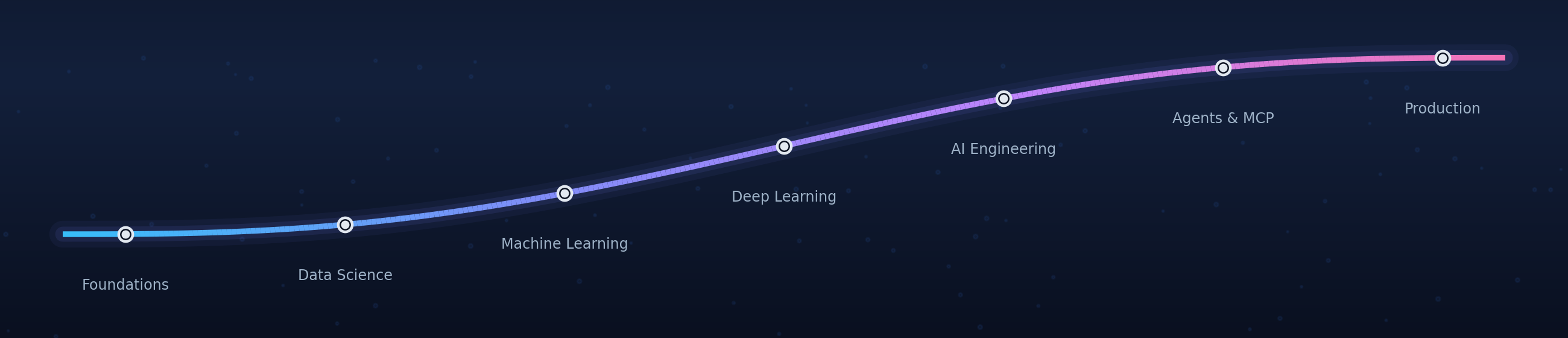
The twenty modules fall into six stretches, and the sidebar groups them the same way.
Python foundations (modules 1–4) build the language itself, then the data stack — pandas, NumPy, plotting, statistics and time series — and finally how data actually arrives: HTTP APIs, SQL, validation, and web scraping.
Machine learning & applications (5–7) covers scikit-learn and honest evaluation, deep learning with PyTorch, and then the module where the tools become the job: Industry Applications, whose four core notebooks and fourteen full-weight appendices all run the same spine — model → money → decision.
AI engineering & agents (8–10) layers LLMs on top of that: prompting, RAG, document processing, evaluation and observability, three proof-of-concept builds, then agent architectures and the Model Context Protocol.
Production & delivery (13–14) turns notebooks into projects, schedules them, and ships them — Docker, GitHub Actions, registries, HTTPS and a real deployment.
Capstones & business (15–16) proves the whole thing end to end, then steps back to digital transformation, architecture patterns and AI governance.
Optional tracks run alongside: text analytics and deep tabular learning (11–12), and three closers — Django, compound-AI evaluation, and containers (17–19). All are fully offline, like everything else.
How to read a module page
Each module page is that module’s own guide: what you’ll learn, the notebooks in order with time estimates and difficulty, the exercises, and how it connects to the modules on either side. Notebook names link straight to GitHub, where the Colab badge at the top of every notebook opens it in a browser — nothing to install. The three mini-book modules (CI/CD, Django, and Containers & Docker) additionally have their full prose chapters here, listed in the sidebar in reading order.
Every lesson is built the same way: short teaching sections broken up by ✋ quick-exercise checkpoints with collapsible solutions, then graded practice, stretch problems and a bonus mini-project. All 389 checkpoint solutions are executed in a fresh kernel before release, so the code on these pages is code that runs.
Browse the course
Start here
Python foundations
Machine learning & applications
AI engineering & agents
Optional: text & tabular
Production & delivery
Capstones & business
Optional closers
Course-wide
For maintainers